

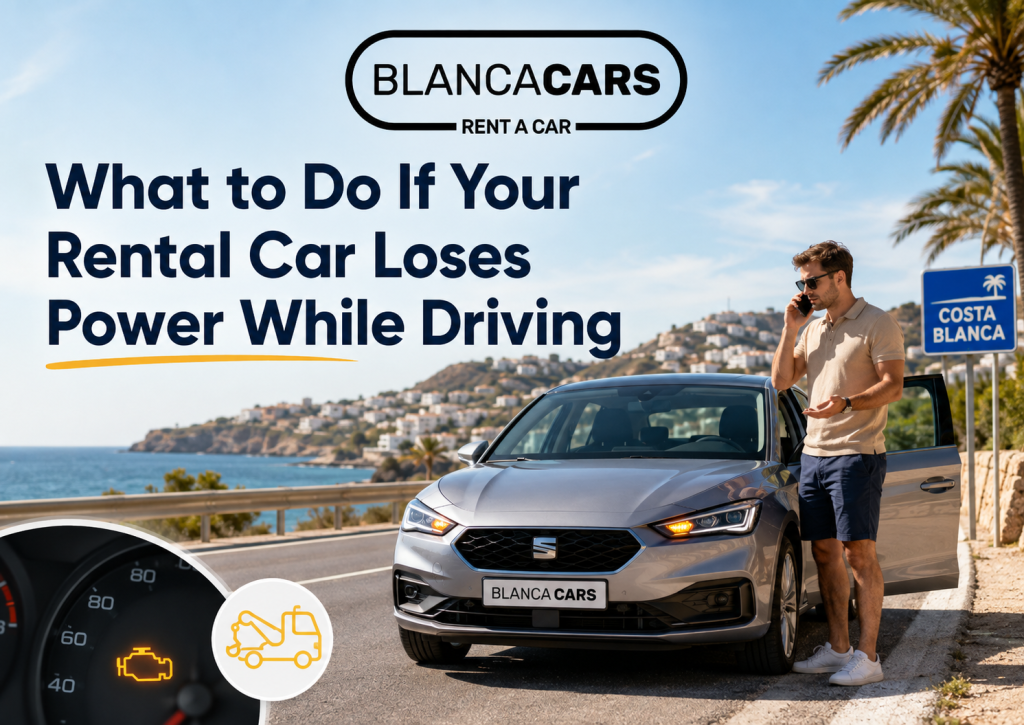
A rental car suddenly losing power while you are driving can be frightening, particularly when you are in another country and travelling on an unfamiliar road.
You may press the accelerator and notice that the car does not respond normally.
Perhaps it struggles to maintain speed, will not accelerate beyond a certain point, or an engine warning light suddenly appears on the dashboard.
In some cases, the vehicle may deliberately reduce its own performance because its computer has detected a problem. This is commonly referred to as limp mode, emergency mode or self-protection mode.
Spain’s Dirección General de Tráfico (DGT) explains that when certain faults are detected, a vehicle may automatically limit engine power and engine speed to help protect important mechanical components.
Whatever the cause, the important rule for Blanca Cars customers is:
Do not try to force the car to keep driving normally. Reduce your speed, get somewhere safe and contact Blanca Cars.
How Do You Know Your Rental Car Is Losing Power?
A loss of power can happen suddenly or become noticeable over several minutes.
Common signs include:
- The car responding slowly when you press the accelerator
- Difficulty maintaining normal road speed
- The vehicle struggling when travelling uphill
- Engine revs being restricted
- A yellow engine warning light appearing
- A “reduced engine power” or similar dashboard message
- Unusual vibration
- Rough engine running
- Excessive or unusual exhaust smoke
- The engine cutting out
- Several warning lights appearing together
Sometimes the vehicle may still drive reasonably well at lower speeds.
That does not mean the problem should be ignored.
A sudden and noticeable change in performance is a reason to stop somewhere safe and seek advice.
First: Stay Calm and Keep Control of the Vehicle
If the vehicle loses power while you are moving, your immediate priority is maintaining control.
Keep both hands on the steering wheel.
Do not slam on the brakes unless there is an immediate danger.
Do not make sudden lane changes.
Check your mirrors and be aware that vehicles approaching from behind may not realise that your car is slowing down.
If your speed is falling significantly below the traffic around you, switch on the hazard warning lights to make other road users aware that you have a problem.
Then begin looking for the safest possible place to stop.
Do Not Keep Pressing the Accelerator Harder
One of the natural reactions when a car loses power is to press the accelerator harder.
Avoid doing this.
If the vehicle has entered emergency or limp mode, the reduced performance may be deliberate.
The DGT explains that when self-protection mode activates, a car can suddenly lose power and prevent the engine reaching higher revolutions even if the driver continues trying to accelerate. The purpose is to reduce the possibility of further damage.
Trying to force more performance from the engine is therefore unlikely to solve the problem.
Concentrate on getting somewhere safe instead.
Find a Safe Place to Stop
If the vehicle can still move normally enough to reach a safe location, look for somewhere away from moving traffic.
Suitable places can include:
- A motorway service area
- Petrol station
- Motorway exit
- Lay-by
- Car park
- Wide and safe roadside area
Avoid continuing all the way to your hotel, villa or destination simply because the car is technically still moving.
If something has caused a sudden loss of power, continuing a long journey could make the underlying problem worse or leave you stranded somewhere less safe.
Once safely parked, stop the vehicle and contact Blanca Cars.
What If the Car Loses Power on the A-7 or AP-7?
The A-7 and AP-7 are frequently used by visitors travelling along the Costa Blanca between Alicante, Benidorm, Altea, Calpe, Moraira, Jávea, Dénia and Valencia.
Losing power on a high-speed road requires extra care.
If it happens:
Stay calm.
Switch on your hazard lights if the car is slowing significantly.
Check your mirrors.
Move towards a safer position gradually.
If the vehicle is capable of reaching a nearby exit or service area safely, this may be preferable to stopping alongside fast-moving traffic.
However, do not attempt to travel a long distance simply to find a more convenient location.
If the vehicle can no longer continue safely, stop as far away from active traffic as possible.
Use the V-16 Emergency Beacon If the Car Becomes Immobilised
If your rental vehicle becomes immobilised on a Spanish road, follow Spain’s current breakdown procedures.
DGT’s current emergency guidance states that breakdowns in Spain are signalled using the V-16 warning beacon.
For a Blanca Cars rental vehicle equipped with a V-16:
Activate the beacon and place it on top of the vehicle, normally on the roof.
The aim is to warn approaching drivers without requiring you to walk along the road.
If you can safely leave the vehicle and move to a protected area away from traffic, follow the official roadside instructions.
If getting out would expose you to greater danger, prioritise your personal safety.
For more detailed advice, see our guide:
Rental Car Breakdown on a Motorway in Spain: Step-by-Step Guide
Check the Dashboard Once You Are Safe
Once the vehicle is safely stopped, look carefully at the dashboard.
You may see:
- Yellow engine-management light
- Red oil-pressure warning
- Temperature or coolant warning
- Battery or charging-system warning
- Tyre warning
- Gearbox warning
- “Reduced engine power”
- Other written warning messages
Take a photograph of the dashboard if possible.
This can be extremely helpful when speaking to Blanca Cars because it allows us to see exactly what the vehicle is reporting.
Do not reset warning lights yourself.
Do not disconnect the battery.
Do not use diagnostic equipment or attempt to clear fault codes from a rental vehicle.
What Is Limp Mode?
“Limp mode” is an informal name for an emergency or self-protection mode used by many modern cars.
The vehicle’s electronic systems constantly monitor the engine, transmission and other important components.
If a significant fault is detected, the computer can restrict performance.
The DGT explains that emergency mode may cause sudden power loss, limit engine revolutions and reduce maximum vehicle speed. Automatic gearboxes can also restrict which gears are available when certain faults are detected.
The purpose is not to inconvenience the driver.
It is designed to protect the vehicle from potentially greater damage and, in some circumstances, allow it to reach a safer location.
What Can Cause a Car to Lose Power?
There are many possible causes.
DGT identifies several types of faults that can trigger emergency mode, including problems involving:
- Engine control systems
- Turbocharger or boost pressure
- Engine sensors
- Ignition coils
- Airflow measurement
- Fuel injection
- Automatic transmission
- Excessive engine temperature
- Diesel particulate filters
Some diesel vehicles may also produce unusual smoke if a particulate-filter problem is involved.
You do not need to work out which component has failed.
As a rental customer, your job is simply to describe what happened and allow Blanca Cars or the authorised roadside-assistance provider to investigate.
Pay Particular Attention to Red Warning Lights
Loss of power accompanied by a red warning light should always be treated seriously.
Examples include a red:
- Oil-pressure warning
- Engine-temperature warning
- Brake warning
- Charging-system warning in combination with other symptoms
If a serious warning appears, get somewhere safe and switch the engine off.
Do not continue driving simply to see whether the warning disappears.
For more information, read:
Dashboard Warning Lights in a Rental Car in Spain
What If the Vehicle Is Overheating?
Loss of power can sometimes happen when an engine becomes too hot.
DGT notes that excess engine temperature is one possible trigger for emergency mode and can be particularly relevant during hot weather.
If you see:
- A red temperature warning
- Temperature gauge in the red
- Steam from under the bonnet
- An overheating message
stop somewhere safe and switch the engine off.
Do not open the coolant cap while the engine is hot.
Contact Blanca Cars.
You can also read our guide:
Rental Car Overheating in Spain: What to Do Immediately
Contact Blanca Cars
Once you and your passengers are safe, contact Blanca Cars.
Blanca Cars provides 24-hour roadside assistance with its rental service.
The emergency telephone number currently published by Blanca Cars is:
+34 653 221 333
If you rented through one of our partner arrangements, check the emergency information supplied with the vehicle or in the glove compartment.
When calling, tell us:
- Your name
- Which vehicle you are driving
- Your location
- What happened
- Whether the engine is still running
- Whether the vehicle can still move
- Which warning lights appeared
- Whether there was smoke or steam
- Whether the vehicle made unusual noises
- Whether you are safely away from traffic
If you are on a motorway, provide the road number, direction of travel, nearest exit or kilometre marker if available.
Do Not Arrange Your Own Repair
Do not independently arrange:
- Mechanical repairs
- Tow trucks
- Diagnostic work
- Battery replacement
- Engine repairs
- Gearbox repairs
without speaking to Blanca Cars first.
The rental service includes roadside assistance, so contact us and allow the appropriate assistance to be coordinated.
This avoids unnecessary work and ensures the vehicle is handled correctly.
What If the Car Seems Normal After Restarting?
A vehicle can occasionally appear to return to normal after being switched off and restarted.
That does not necessarily mean the fault has disappeared.
DGT notes that an emergency mode can sometimes clear temporarily following a restart, but it also explains that faults commonly require professional diagnosis and repair.
With a rental vehicle, do not repeatedly restart the car to try to clear a warning.
If your Blanca Cars vehicle has suffered a significant sudden loss of power, contact us before continuing a long journey.
What If the Engine Stops Completely?
If the engine cuts out while you are driving, keep calm.
Your steering or braking may feel different after the engine stops.
Keep control of the vehicle and turn on your hazard warning lights.
Move away from traffic as safely as possible.
Once stopped:
Do not repeatedly try to restart the engine.
Use the V-16 beacon if the vehicle is immobilised on the road.
Contact Blanca Cars.
If there has been a collision, someone is injured, the vehicle is in an immediately dangerous position or another serious emergency exists, call 112.
DGT lists 112 as Spain’s general emergency number for situations requiring emergency services.
Frequently Asked Questions
Can I Keep Driving if My Rental Car Has Lost Power?
Do not continue a long journey after a sudden significant loss of power.
Find somewhere safe to stop and contact Blanca Cars.
What Is Limp Mode?
Limp mode is a self-protection system that may deliberately restrict engine power or speed when the vehicle detects a fault.
Does Limp Mode Mean the Engine Is Broken?
Not necessarily.
There are many possible causes, ranging from sensors to engine, transmission, temperature or emissions-system problems.
Professional diagnosis may be required.
Should I Restart the Car?
Do not repeatedly restart a rental vehicle to try to clear the fault.
Contact Blanca Cars and follow the instructions provided.
What If a Red Warning Light Appears?
Get somewhere safe and stop.
A red oil-pressure, overheating or other serious warning should not be ignored.
What If the Car Loses Power on a Motorway?
Switch on your hazards if necessary, move away from active traffic safely and use the V-16 beacon if the vehicle becomes immobilised.
Then contact Blanca Cars.
Does Blanca Cars Include Roadside Assistance?
Yes. Blanca Cars currently states that 24-hour road assistance is included with its rental service.
Remember: Don’t Try to Drive Through the Problem
If your Blanca Cars rental vehicle suddenly loses power while driving in Spain:
STAY CALM.
KEEP CONTROL OF THE VEHICLE.
USE YOUR HAZARD LIGHTS IF YOU ARE SLOWING SIGNIFICANTLY.
MOVE TO A SAFE LOCATION.
DO NOT FORCE THE ENGINE TO KEEP GOING.
CHECK THE DASHBOARD FOR WARNING LIGHTS.
USE THE V-16 IF THE VEHICLE BECOMES IMMOBILISED.
CONTACT BLANCA CARS ON +34 653 221 333.
A vehicle losing power does not automatically mean that a major mechanical failure has occurred.
However, it is a clear sign that something may not be operating normally.
Stopping safely and contacting Blanca Cars gives us the opportunity to advise you and arrange the appropriate assistance before the problem becomes more serious.
For official roadside safety information in Spain, the Dirección General de Tráfico (DGT) provides current guidance for drivers dealing with breakdowns and other roadside emergencies.