

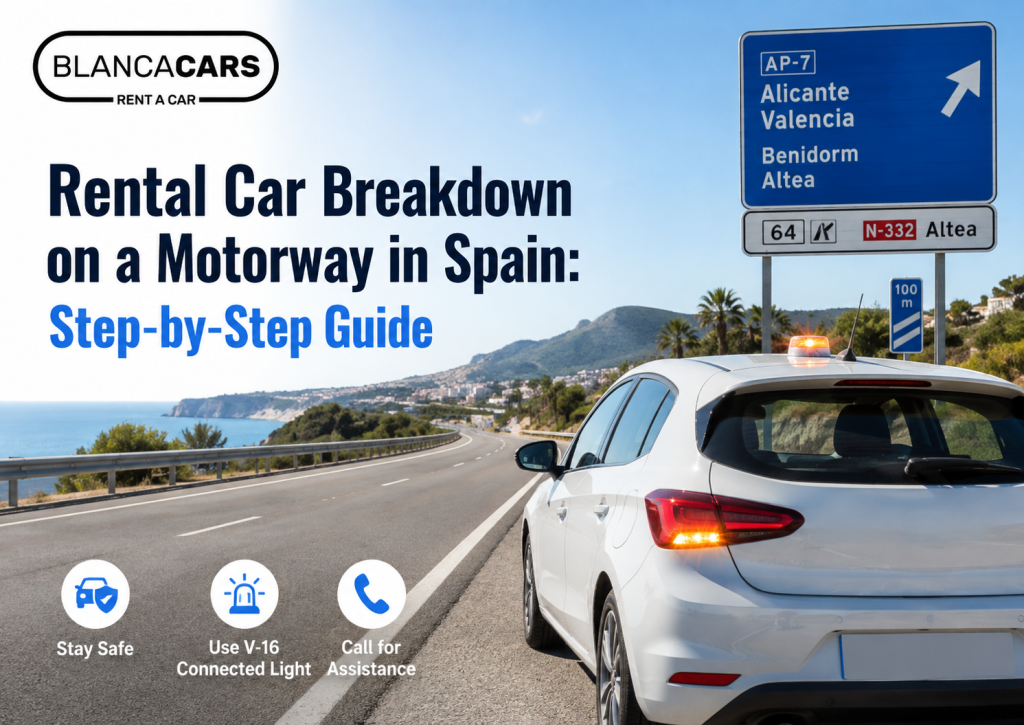
Breaking down on a motorway is stressful at the best of times. When you are driving a rental car in Spain, possibly in an unfamiliar area and surrounded by fast-moving traffic, knowing exactly what to do becomes even more important. Whether you are travelling on the A-7, AP-7 or another Spanish autopista or autovía, your first priority is not the car.
Your first priority is keeping yourself and your passengers safe.
Spain also has specific rules for signalling an immobilised vehicle. Since 1 January 2026, the connected V-16 emergency beacon is the legal warning device for Spanish-registered cars and has replaced the traditional warning triangles.
If a Blanca Cars rental vehicle breaks down, follow this step-by-step guide.
Check out our FAQ section for other topics
Step 1: Stay Calm and Get the Car Away From Moving Traffic
If you notice something wrong with the vehicle while driving, do not make sudden movements.
Possible warning signs include:
- Loss of engine power
- A tyre suddenly losing pressure
- Smoke or steam
- A serious dashboard warning light
- Unusual engine noises
- Steering problems
- Engine cutting out
- Electrical systems failing
Switch on your hazard warning lights as soon as you realise that you may need to stop.
If the vehicle is still moving, carefully move towards the safest available stopping place.
Where possible, try to reach:
- A motorway exit
- Service area
- Emergency stopping area
- Lay-by
- Another location away from active traffic
If this is not possible, move as far away from the live traffic lanes as you safely can.
Never make a dangerous manoeuvre simply because you are trying to reach an exit.
Step 2: Do Not Try to Continue Driving a Seriously Faulty Car
Trying to travel “just another few kilometres” can turn a manageable breakdown into a more serious problem.
For example, you should not continue driving normally if:
- A tyre is completely flat
- The engine is overheating
- There is smoke from the vehicle
- The oil-pressure warning is illuminated
- The steering has become difficult
- The car has lost significant power
- You hear serious grinding or knocking noises
If you are unsure whether it is safe to continue, stop safely and contact Blanca Cars.
Do not risk damaging the vehicle further simply to reach your hotel, villa or next motorway exit.
Step 3: Activate Your Hazard Warning Lights
Keep the hazard lights operating while the vehicle is immobilised.
They provide an immediate visual warning to approaching traffic.
However, hazard lights are not the only warning system used for breakdowns in Spain.
You also need to use the vehicle’s V-16 emergency beacon where required.
Step 4: Use the V-16 Emergency Beacon
Spain has replaced roadside warning triangles with the connected V-16 emergency beacon for Spanish-registered passenger cars.
The important advantage of the V-16 is that you no longer need to walk along a motorway or hard shoulder to place warning triangles behind the vehicle.
That greatly reduces your exposure to fast-moving traffic.
The beacon should be activated and placed as high as possible on the vehicle, normally on the roof.
Once activated, an approved connected V-16 beacon flashes to warn approaching drivers and automatically transmits the location of the immobilised vehicle to the DGT 3.0 system. That information can then be shared through connected navigation systems, mobility applications and motorway information panels.
Important: Put the V-16 on the Roof
Do not place the beacon on the road behind the vehicle.
The V-16 should normally be placed on top of the vehicle’s roof, where it can provide maximum visibility.
The whole point of the system is to avoid having drivers walking along the carriageway or hard shoulder carrying warning triangles.
Step 5: Decide Whether It Is Safe to Leave the Vehicle
This is one of the most important decisions during a motorway breakdown.
Spanish DGT guidance states that, as a general rule, occupants of an immobilised vehicle should leave it when there is a safe place outside the carriageway and they can reach that location safely.
Passengers should leave on the side away from traffic and should not walk or remain in traffic lanes or on the carriageway.
However, if traffic conditions mean leaving the vehicle would be more dangerous, occupants should remain inside with their seatbelts fastened.
If You Can Leave Safely
If there is a safety barrier and you can reach the protected area without exposing yourself to traffic:
- Leave from the side furthest away from moving vehicles
- Wear a reflective vest
- Move behind the safety barrier
- Keep children and other passengers well away from the road
- Wait in a safe location for assistance
Official DGT guidance for foreign visitors likewise advises leaving by the side away from traffic, wearing a reflective vest and waiting somewhere protected, such as behind a safety barrier or outside the carriageway.
If You Cannot Leave Safely
If getting out would require stepping into fast-moving traffic, crossing a live lane or exposing passengers to a greater danger:
Stay inside the vehicle.
Keep your seatbelts fastened and wait for assistance.
Do not stand beside the car on the motorway simply because you feel safer outside.
Step 6: Do Not Attempt Roadside Repairs in a Dangerous Location
A motorway hard shoulder is not a workshop.
Do not start:
- Changing a tyre
- Looking underneath the vehicle
- Opening components you do not understand
- Attempting electrical repairs
- Jump-starting the vehicle yourself in moving traffic
- Adding fluids without instructions
- Trying to push the vehicle
Even a seemingly simple repair can place you dangerously close to passing traffic.
Contact Blanca Cars first and follow the instructions provided.
Step 7: Contact Blanca Cars
If your Blanca Cars rental vehicle breaks down, use the emergency number supplied with your rental vehicle.
Blanca Cars states that an emergency telephone number is provided in the glove compartment and that a member of the team will assist customers whose vehicle has broken down or suffered a flat tyre.
The Blanca Cars website currently lists the emergency number as:
+34 653 221 333
Your rental agreement also contains the 24-hour emergency contact details.
Blanca Cars rental agreements include roadside assistance, so contact us before arranging your own towing company, mechanic or repair.
Step 8: Tell Blanca Cars Exactly Where You Are
One of the biggest challenges during a motorway breakdown can be explaining your location.
When calling, provide as much information as possible.
Useful information includes:
- Motorway number, such as A-7 or AP-7
- Direction of travel
- Nearest town
- Nearest motorway exit
- Kilometre marker
- Service area
- Nearby signs or landmarks
- Your phone’s GPS location
For example:
“We are on the AP-7 travelling north towards Valencia, just after exit 63 near Benissa.”
That is far more useful than simply saying:
“We’re somewhere near Alicante.”
If possible, use Google Maps, Apple Maps or another navigation application to identify your exact position before calling.
Step 9: Explain What Happened
Tell the Blanca Cars representative what happened immediately before the breakdown.
For example:
- “The engine lost power.”
- “A red warning light appeared.”
- “The temperature warning came on.”
- “The front tyre is completely flat.”
- “The engine stopped while driving.”
- “The car will not restart.”
- “There was a loud noise from the wheel.”
- “The battery warning light came on.”
Do not try to diagnose the problem if you are unsure.
Simply describe what you saw, heard and felt.
That information can help determine what assistance is required.
Step 10: Call 112 If There Is an Immediate Emergency
A mechanical breakdown and an emergency are not always the same thing.
However, call 112 immediately if:
- Someone has been injured
- The vehicle is in a highly dangerous position
- There has been a serious collision
- There is a fire
- You require urgent police, fire or medical assistance
Spain uses 112 as the general emergency number, and DGT identifies it as the number for coordinating the necessary emergency services.
For an ordinary mechanical breakdown where everyone is safe, contact Blanca Cars using the rental emergency assistance number.
What If You Break Down on the A-7 or AP-7?
The A-7 and AP-7 are particularly relevant to Blanca Cars customers because they provide major north-south connections along Spain’s Mediterranean coast.
Many visitors use these roads when travelling between Alicante Airport, Benidorm, Altea, Calpe, Benissa, Moraira, Jávea, Dénia and Valencia.
The same safety procedure applies:
Hazards on.
Move away from live traffic if possible.
Place the V-16 on the roof.
Get passengers somewhere safe if this can be done without entering traffic.
Contact Blanca Cars.
Do not walk along the motorway looking for assistance.
What If the Breakdown Happens at Night?
A motorway breakdown at night requires even greater caution.
Your vehicle may be much harder for other drivers to see.
Keep the hazard warning lights operating and activate the V-16 beacon.
The V-16 provides a flashing warning above the vehicle and, with approved connected models, also sends the breakdown location digitally through DGT 3.0.
Do not use your mobile phone torch as a substitute for the proper warning equipment.
If you leave the vehicle, only do so when you can reach a genuinely safe location.
What If the Breakdown Is Inside a Tunnel?
If the vehicle develops a problem inside a tunnel and can safely continue to an exit or designated emergency area, use that option.
If the vehicle becomes immobilised:
- Switch on the hazard lights
- Stop as safely as possible
- Follow tunnel emergency signage
- Use emergency facilities where available
- Follow instructions from tunnel operators or emergency services
- Contact Blanca Cars when safe to do so
Do not stand in a live traffic lane.
The connected V-16 remains a visual warning device even in circumstances where network communication may be temporarily unavailable. DGT guidance also states that connected V-16 units are designed to transmit location through specialised networks.
What If the Car Has a Flat Tyre?
If the breakdown is caused by a flat tyre, do not continue driving normally on it.
Move somewhere safe, activate the hazard lights and use the V-16 beacon where necessary.
Contact Blanca Cars before attempting a tyre change or repair.
Blanca Cars’ current rental terms state that tyre and wheel damage is excluded from standard insurance cover, so customers should always contact the company to establish the correct next step.
For more detailed information, see our guide:
What to Do If You Get a Flat Tyre in a Rental Car in Spain
What If the Car Won’t Start?
If the vehicle is safely stopped but will not restart, avoid repeatedly turning the key or pressing the start button.
There may be a battery, electrical or mechanical problem.
Contact Blanca Cars and explain whether:
- Dashboard lights appear
- You hear clicking
- The starter turns
- The engine starts and immediately stops
- A warning message appears
For more information, read:
Rental Car Won’t Start in Spain: What Should You Do?
Never Arrange Repairs Without Contacting Blanca Cars
Do not independently authorise:
- Towing
- Mechanical repairs
- Battery replacement
- Tyre replacement
- Recovery services
unless Blanca Cars has instructed you to do so.
The rental agreement includes roadside assistance, and Blanca Cars should coordinate what happens to the rental vehicle.
This also helps avoid confusion about responsibility, insurance and payment.
Frequently Asked Questions
What Is the First Thing I Should Do If My Rental Car Breaks Down on a Spanish Motorway?
Switch on the hazard warning lights and move the vehicle away from active traffic if it is safe to do so.
Once stopped, activate the V-16 emergency beacon and place it on the roof.
Do I Still Need Warning Triangles in Spain?
For Spanish-registered passenger cars, the connected V-16 became the legal warning device from 1 January 2026, replacing warning triangles.
Where Should I Put the V-16 Beacon?
Place the activated beacon as high as possible on the vehicle, normally on top of the roof.
Should I Get Out of the Car?
Only if you can safely reach a protected location away from the carriageway.
Exit on the side away from traffic.
If leaving the vehicle would expose you to greater danger, remain inside with your seatbelt fastened.
Should I Try to Repair the Car Myself?
Not beside a motorway.
Contact Blanca Cars and follow the assistance instructions you are given.
Does Blanca Cars Include Roadside Assistance?
Yes. Blanca Cars’ current terms include roadside assistance with the rental agreement and provide a 24-hour emergency contact number.
When Should I Call 112?
Call 112 if there are injuries, fire, a serious accident or another situation requiring urgent police, ambulance or fire-service assistance.
Remember These Six Steps
If your Blanca Cars rental vehicle breaks down on a motorway in Spain, remember:
1. HAZARD LIGHTS ON.
2. GET AS FAR AWAY FROM MOVING TRAFFIC AS SAFELY POSSIBLE.
3. ACTIVATE THE V-16 AND PLACE IT ON THE ROOF.
4. MOVE PASSENGERS TO A SAFE LOCATION ONLY IF IT IS SAFE TO DO SO.
5. CONTACT BLANCA CARS.
6. CALL 112 IF THERE IS AN IMMEDIATE EMERGENCY.
Do not put yourself in danger trying to repair the car beside a motorway.
The vehicle can be repaired or recovered.
Your safety and the safety of your passengers come first.
If you are driving a Blanca Cars rental car and experience a breakdown, use the emergency contact information supplied with the vehicle and contact Blanca Cars for assistance.
For official information about what to do during a roadside emergency in Spain, the Dirección General de Tráfico (DGT) provides dedicated guidance for foreign drivers.