

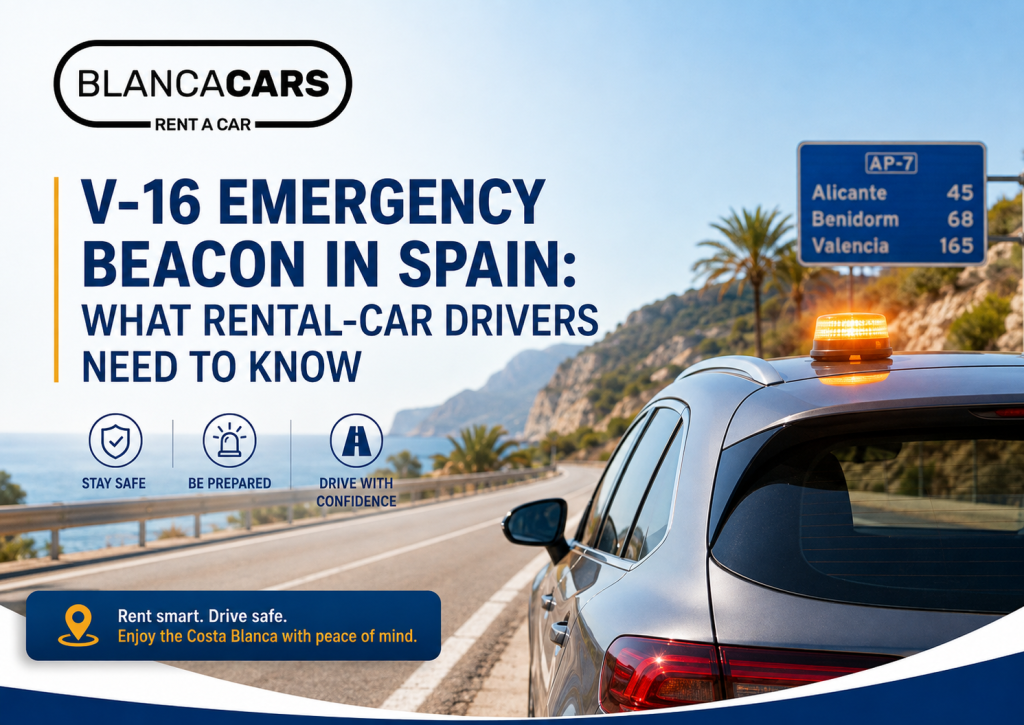
If you are renting a car in Spain, there is one piece of emergency equipment you should know about before setting off: the connected V-16 emergency beacon. From 1 January 2026, Spain changed the way broken-down and immobilised vehicles are signalled to other road users.
For Spanish-registered vehicles, the connected V-16 beacon replaced the traditional roadside warning triangles as the legal method of warning other drivers about a vehicle that has broken down or been involved in an accident.
For visitors renting a car on the Costa Blanca, understanding how the V-16 works could make a significant difference if you ever have to stop unexpectedly on the A-7, AP-7, N-332 or another Spanish road.
The most important point to remember is simple:
The V-16 beacon should be activated and placed on top of the vehicle, normally on the roof.
You should not walk down the road to place it behind the car.
What Is a V-16 Emergency Beacon?
A V-16 is a small portable emergency warning light designed to make an immobilised vehicle clearly visible to approaching traffic.
When activated, it produces a bright flashing amber light that can be seen from different directions.
Approved connected V-16 devices also transmit the location of the immobilised vehicle to Spain’s DGT 3.0 connected traffic system.
This allows information about the stopped vehicle to be shared digitally with traffic-management systems and potentially with navigation services and motorway information boards.
The V-16 was introduced primarily to make roadside emergencies safer.
With the old warning-triangle system, drivers could have to leave the vehicle and walk along the roadside to position triangles behind the car.
On motorways and other fast roads, this could put people dangerously close to moving traffic.
The V-16 is designed to be placed without walking along the road.
Where Should the V-16 Beacon Be Placed?
The beacon should normally be placed on the roof of the vehicle.
The aim is to position it as high as possible so that the flashing light can be seen clearly by approaching traffic.
In most cases, the magnetic base allows the beacon to attach directly to the vehicle’s roof.
You should activate the beacon first and then place it on the highest safe point of the vehicle.
If the design of the vehicle makes the roof inaccessible, follow the instructions supplied with the beacon and position it somewhere that gives maximum visibility.
But for a normal passenger car, remember:
V-16 = ON THE ROOF.
Do not place it on the road behind the vehicle.
When Should You Use the V-16?
The V-16 is intended for situations where your vehicle has become immobilised because of a breakdown, accident or other emergency.
Examples include:
- A flat tyre
- Engine failure
- A vehicle that will not restart
- Overheating
- Electrical failure
- Loss of engine power
- A collision
- Another fault that means the vehicle cannot safely continue
If you can safely move the vehicle completely away from moving traffic, do so before dealing with the emergency.
Once the vehicle is stopped, switch on the hazard warning lights and use the V-16 beacon where required.
What Should Blanca Cars Customers Do?
If a Blanca Cars rental vehicle becomes immobilised, your first priority is always safety.
Follow these steps:
- Switch on the hazard warning lights.
- Move the vehicle away from active traffic if it is safe and possible to do so.
- Activate the V-16 emergency beacon.
- Place the V-16 on top of the vehicle, normally on the roof.
- Move passengers to a protected location if this can be done safely.
- Contact Blanca Cars using the emergency contact information provided with the rental vehicle.
- Do not arrange independent repairs or recovery unless instructed to do so.
If anyone is injured, there is a fire, or the vehicle is in an immediately dangerous position, call the Spanish emergency number 112.
Do You Still Need Warning Triangles in Spain?
For Spanish-registered passenger vehicles, the connected V-16 became the legal roadside warning device from 1 January 2026.
That means the traditional procedure of walking behind the vehicle to place warning triangles has been replaced by the connected beacon.
This is particularly important for visitors who have previously driven in Spain and may remember being told to carry two warning triangles.
The purpose of the change is largely about reducing the need for drivers to walk into potentially dangerous roadside areas.
For rental-car drivers, you should use the emergency equipment supplied with your vehicle and follow the instructions given by the rental company.
Why Is the V-16 Safer Than Warning Triangles?
Imagine your car develops a problem on a busy motorway.
With warning triangles, you might have needed to leave the vehicle carrying the triangle and walk some distance along the hard shoulder.
Cars and lorries could be passing only a few metres away at motorway speeds.
With a V-16 beacon, the driver can normally retrieve the device from inside the vehicle, activate it and place it directly on the roof.
This significantly reduces the amount of time you may need to spend outside near traffic.
The beacon also provides 360-degree visibility rather than only warning drivers approaching from one direction.
What Does the “Connected” Part Mean?
Modern approved V-16 beacons do more than simply flash.
Once activated, a connected beacon sends the location of the immobilised vehicle to DGT 3.0, Spain’s connected traffic platform.
The system is designed to improve awareness of hazards on the road.
Traffic authorities can use that information when managing incidents, while digital road systems can alert other motorists that a stopped vehicle may be ahead.
The device does not work like a normal mobile phone application.
Drivers do not normally need to create a personal account or connect the beacon to their own smartphone before using it.
The communication system is built into the approved device.
Where Should the V-16 Be Kept in the Car?
Emergency equipment is most useful when you can reach it easily.
The V-16 should therefore be stored somewhere accessible from inside the vehicle.
The glove compartment is a logical location.
You do not want the beacon buried underneath suitcases in the boot if the car has stopped beside a busy motorway.
When collecting your rental car, it is sensible to familiarise yourself with the emergency equipment supplied with the vehicle.
You do not need to activate the beacon.
Simply knowing where it is can save valuable time if an emergency occurs later.
What If You Break Down on the A-7 or AP-7?
The A-7 and AP-7 are among the most important roads for visitors travelling along the Costa Blanca.
Blanca Cars customers commonly use these routes when travelling between Alicante, Benidorm, Altea, Calpe, Benissa, Moraira, Jávea, Dénia and Valencia.
If your vehicle becomes immobilised on one of these high-speed roads:
Turn on your hazard lights.
Move away from the live traffic lanes wherever possible.
Activate the V-16.
Place it on the roof.
Get yourself and passengers somewhere protected if this can be done safely.
Contact Blanca Cars.
Do not walk along the motorway to place warning equipment.
Should You Leave the Vehicle?
Whether you should leave the car depends on where it has stopped.
If you can safely exit on the side away from traffic and reach a protected location behind a safety barrier or away from the carriageway, that may be the safest place to wait.
However, there are situations where getting out of the vehicle could expose you to greater danger.
If leaving requires stepping into moving traffic or crossing an active lane, it may be safer to remain inside the vehicle with your seatbelt fastened until help arrives.
Every situation is different.
Your personal safety and the safety of your passengers always come before the vehicle.
What If You Get a Flat Tyre?
A flat tyre is one of the situations where the V-16 may be required if the vehicle becomes immobilised.
Do not continue driving normally on a completely flat tyre simply to reach your hotel or accommodation.
Find the safest available stopping position.
Switch on the hazards.
Use the V-16 beacon.
Then contact Blanca Cars.
Do not automatically start changing the wheel at the side of a busy road.
For detailed advice, read our guide:
What to Do If You Get a Flat Tyre in a Rental Car in Spain
What If the Rental Car Won’t Start?
A vehicle that refuses to start while safely parked does not necessarily require the same immediate roadside procedure as a car immobilised in a live traffic environment.
If the vehicle is safely parked at your accommodation, hotel or another secure location, contact Blanca Cars and follow the instructions provided.
If the vehicle has stopped in a dangerous roadside position, use your hazard lights and V-16 beacon as appropriate.
You can also read:
Rental Car Won’t Start in Spain: What Should You Do?
What If You Break Down at Night?
A V-16 can be particularly valuable after dark.
A broken-down vehicle can be much harder for approaching motorists to see at night.
Keep the hazard lights operating and place the activated V-16 on the roof.
The flashing amber warning light helps make the vehicle more visible from a distance.
Never rely only on your phone’s torch to warn approaching vehicles.
Should You Try to Repair the Car Yourself?
Not if doing so puts you close to moving traffic.
A motorway or busy roadside is not a safe place to diagnose a mechanical problem.
Do not attempt to:
- Crawl underneath the vehicle
- Carry out electrical repairs
- Change a tyre beside fast traffic
- Push the vehicle along a motorway
- Repair the engine
- Arrange an unauthorised tow truck
- Take the car to an independent garage without approval
Contact Blanca Cars and follow the instructions provided.
Frequently Asked Questions
Is the V-16 Mandatory in Spain?
For Spanish-registered vehicles covered by the requirement, the connected V-16 became the legal roadside warning device from 1 January 2026.
Where Do I Put the V-16 Beacon?
Place the activated beacon on top of the vehicle, normally on the roof, so it is as visible as possible.
Do I Put the V-16 on the Road Behind the Car?
No.
Unlike warning triangles, the V-16 is designed to be placed directly on the vehicle.
Does the V-16 Need My Mobile Phone?
Approved connected V-16 beacons have their own connectivity for transmitting the vehicle’s location to DGT 3.0. You do not normally need to pair the device with your phone.
Should I Carry Warning Triangles as Well?
The connected V-16 replaced warning triangles as the prescribed warning system for Spanish-registered passenger vehicles from 1 January 2026.
Rental customers should always use the emergency equipment supplied with their vehicle.
Should I Leave the Car After a Breakdown?
Only if you can reach a genuinely safe location without putting yourself in greater danger.
Exit on the side away from traffic wherever possible.
If leaving the vehicle would require entering moving traffic, remaining inside with your seatbelt fastened may be safer.
What Number Do I Call in an Emergency in Spain?
For an immediate emergency involving injuries, fire, police or another serious danger, call 112.
For an ordinary Blanca Cars breakdown, use the emergency contact information provided with the rental vehicle.
Remember the V-16 Rule
If your rental car becomes immobilised on a road in Spain, remember:
HAZARD LIGHTS ON.
V-16 ACTIVATED.
V-16 ON THE ROOF.
STAY AWAY FROM MOVING TRAFFIC.
CONTACT BLANCA CARS.
CALL 112 FOR A SERIOUS EMERGENCY.
The V-16 may be a small piece of equipment, but knowing how to use it correctly could make a roadside breakdown considerably safer.
Before beginning your Costa Blanca journey, take a moment to familiarise yourself with the emergency equipment in your rental vehicle.
Hopefully you will never need it.
But if you do, you will know exactly what to do.
For official information about connected V-16 emergency beacons, visit the Spanish Dirección General de Tráfico (DGT) V-16 information page.
For information about Blanca Cars rentals and driving on the Costa Blanca, visit www.blancacars.com.