

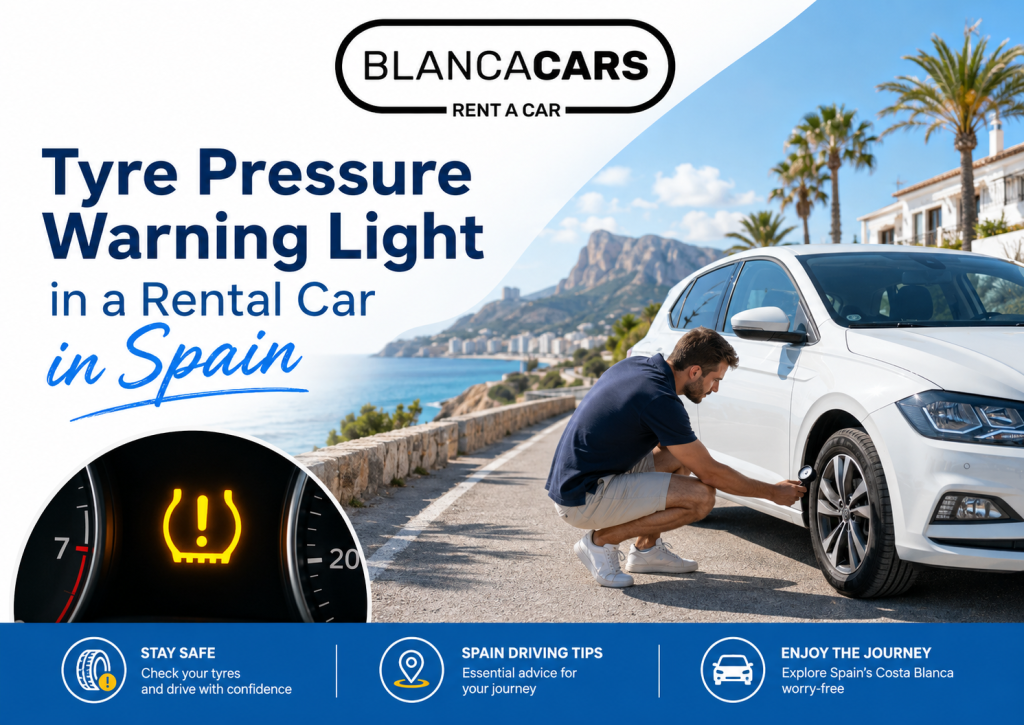
A tyre pressure warning light can appear suddenly while you are driving, and it is something that should never simply be ignored.
You might be driving along the Costa Blanca, travelling on the A-7 or AP-7, or leaving your accommodation when a yellow symbol shaped like a tyre with an exclamation mark appears on the dashboard.
This is the vehicle’s Tyre Pressure Monitoring System, commonly known as TPMS, telling you that one or more tyres may have lost pressure.
Sometimes the cause is relatively minor.
At other times, it could be the first warning of a slow puncture or a tyre that is rapidly losing air.
For Blanca Cars customers, the safest approach is simple:
Reduce your speed, find somewhere safe to stop, visually check the tyres and contact Blanca Cars if you suspect a puncture or are unsure whether it is safe to continue.
Spain’s Dirección General de Tráfico (DGT) stresses that correct tyre pressure is essential for vehicle safety because incorrect pressure affects grip, braking, tyre wear and vehicle handling.
What Does the Tyre Pressure Warning Light Look Like?
The TPMS warning normally looks like an exclamation mark inside a horseshoe-shaped symbol representing the cross-section of a tyre.
It is usually yellow or amber.
When the light appears, the vehicle has detected that the pressure in at least one tyre may be outside the expected range.
Some newer vehicles provide additional information on the dashboard showing the pressure of each individual tyre.
Others simply display the warning symbol.
Do not assume that the warning is unimportant simply because the car appears to be driving normally.
What Should You Do When the Warning Light Appears?
Do not panic or brake suddenly.
Keep control of the vehicle and reduce your speed gradually.
Look for a safe place to stop away from moving traffic.
Suitable locations might include:
- A petrol station
- A motorway service area
- A car park
- A lay-by
- A safe roadside area away from traffic
Once stopped, visually inspect all four tyres.
You are looking for anything obvious, such as:
- One tyre appearing noticeably flatter
- A nail or screw in the tread
- Damage to the tyre sidewall
- A bulge
- A cut
- A damaged wheel
- A tyre that appears to have completely lost its air
If a tyre is clearly flat or damaged, do not continue driving normally.
Why Is Correct Tyre Pressure Important?
Your tyres are the only part of the vehicle that is in constant contact with the road.
Correct pressure is therefore important for steering, braking and overall vehicle stability.
The DGT explains that driving with inadequate tyre pressure reduces the tyre’s contact effectiveness with the road and can reduce grip. Pressure that is too low can also cause irregular wear and increased rolling resistance, while excessive pressure can result in greater wear through the centre of the tyre.
Low pressure can also cause the tyre to become hotter while driving.
This is particularly relevant during summer in Spain, when road and air temperatures can already be high.
DGT guidance warns that under-inflated tyres may overheat and wear prematurely.
Could the Warning Mean You Have a Puncture?
Yes.
A TPMS warning can be the first sign of a slow puncture.
A nail or screw may enter a tyre without causing it to lose all its air immediately.
The tyre might gradually lose pressure over several hours or days.
Possible signs include:
- The warning light returning after being reset
- One tyre looking slightly softer than the others
- The vehicle pulling to one side
- Steering feeling unusual
- Vibration through the steering wheel
- A repetitive noise from one wheel
If you suspect a puncture, contact Blanca Cars.
Do not simply add air repeatedly and continue driving without establishing why the pressure keeps falling.
What If the Tyre Is Completely Flat?
Do not continue driving on a completely flat tyre.
Driving on it can damage the tyre beyond repair and may also damage the wheel.
It can also make the vehicle much more difficult to control.
If the tyre is clearly flat:
Stop.
Switch on your hazard warning lights if necessary.
Do not continue driving.
Contact Blanca Cars.
Blanca Cars specifically instructs customers whose rental car has broken down or suffered a flat tyre to use the emergency phone number provided in the glove compartment, where a Blanca Cars team member will assist them.
Should You Put Air in the Tyre Yourself?
If the warning appears but no tyre looks visibly damaged, you may be tempted to stop at a petrol station and add air.
Before doing so, make sure you know the correct pressure for the vehicle.
DGT guidance states that the recommended tyre pressures are specified by the vehicle manufacturer and can commonly be found in places such as:
- The driver’s door frame
- The fuel filler flap
- Vehicle documentation
The correct pressure can differ between front and rear tyres and can also vary according to how heavily the vehicle is loaded.
If you are unsure, contact Blanca Cars rather than guessing.
Never inflate a tyre to an arbitrary number simply because another car you have driven used that pressure.
Should Tyre Pressure Be Checked When the Tyres Are Hot or Cold?
Ideally, tyre pressure should be checked when the tyres are cold.
The DGT advises checking tyre pressure before a long journey and when the tyres have not been significantly heated by driving.
Tyre pressure naturally increases as tyres heat up during driving.
For this reason, checking immediately after a long motorway journey can produce a higher reading than when the tyres are cold.
Do not deliberately release air from a hot tyre simply because the displayed pressure is above the cold-pressure figure.
If you are unsure what to do, contact Blanca Cars.
Can Hot Weather in Spain Trigger the Warning?
Temperature can affect tyre pressure.
However, you should never dismiss a TPMS warning simply because the weather is hot.
A genuine loss of pressure, slow puncture or other tyre problem may also be responsible.
Spanish summer conditions can put additional stress on tyres, particularly during long motorway journeys.
DGT guidance recommends regularly checking tyre condition and pressure and warns that incorrect tyre pressure combined with high temperatures can increase wear and overheating.
Treat the warning as something that needs checking.
What If the Light Comes On Just After Starting the Car?
The warning may appear immediately when the ignition is switched on.
Some dashboard warning lights briefly illuminate during the vehicle’s normal self-check and then disappear.
If the TPMS warning remains illuminated after the engine is running, or appears while you are driving, it needs attention.
If you are unsure whether what you are seeing is a normal start-up check or a genuine warning, take a photograph of the dashboard and contact Blanca Cars.
Take a Photograph of the Dashboard
Once you are safely stopped, take a clear photograph showing the warning light.
If the vehicle displays individual tyre pressures, photograph those readings as well.
This can make it much easier for Blanca Cars to understand what the vehicle is reporting.
When contacting us, explain:
- Your name
- Which vehicle you are driving
- Your location
- Whether the warning appeared suddenly
- Whether any tyre appears visibly flat
- Whether the car is handling differently
- Whether you can see any obvious tyre damage
Do Not Simply Reset the Warning Light
Some vehicles allow drivers to reset or recalibrate the tyre pressure monitoring system through the dashboard menus.
Do not use this simply to make the warning disappear without first checking why it appeared.
Resetting a warning does not inflate a tyre or repair a puncture.
If pressure has genuinely been lost, the cause still needs to be addressed.
As a rental customer, contact Blanca Cars if you are unsure.
What If the Warning Appears on the A-7 or AP-7?
The A-7 and AP-7 are commonly used by Blanca Cars customers travelling between Alicante, Benidorm, Altea, Calpe, Moraira, Jávea, Dénia and Valencia.
If the tyre-pressure warning appears while you are travelling on one of these roads, do not immediately stop in a dangerous location unless the tyre has failed or the vehicle is becoming difficult to control.
Reduce your speed and, if the vehicle still feels stable, carefully look for a safer location such as an exit or service area.
If the tyre suddenly becomes flat or the vehicle becomes unsafe:
Switch on the hazard warning lights.
Move away from live traffic as safely as possible.
If the vehicle becomes immobilised on the road, use the connected V-16 emergency beacon where required.
Since 1 January 2026, the connected V-16 has been the legal warning device for immobilised vehicles covered by the Spanish requirement and replaces traditional warning triangles. The DGT advises keeping it accessible and placing it preferably on top of the vehicle.
Then contact Blanca Cars.
Should You Change the Wheel Yourself?
Do not automatically attempt a roadside wheel change.
First, contact Blanca Cars and follow the instructions provided.
Modern rental vehicles may have:
- A conventional spare wheel
- A temporary spare
- A tyre repair kit
- No spare wheel at all
More importantly, changing a wheel beside a busy road or motorway can be dangerous.
Your safety is more important than getting the car moving again quickly.
Are Tyre Problems Covered by Blanca Cars?
Blanca Cars includes 24-hour roadside assistance with its rental service.
However, the current Blanca Cars terms state that damage to tyres and wheels is not covered by the standard insurance, and wheel blowouts considered to result from negligent use are also excluded.
That makes it especially important to stop driving if a tyre is clearly flat or damaged.
Continuing to drive could increase the damage.
Contact Blanca Cars and follow the instructions provided for your specific situation.
Do Not Arrange Your Own Tyre Repair
Do not independently take a Blanca Cars vehicle to a tyre shop, buy a replacement tyre or authorise repairs without contacting Blanca Cars first.
Blanca Cars’ terms require customers to notify the company when a warning light or alarm indicates a vehicle abnormality and state that repairs or assistance arranged without prior authorisation will not be paid.
Contact us first so the correct solution can be arranged.
How to Reduce the Risk of Tyre Problems in Spain
Not every puncture can be prevented.
Road debris, screws, nails and unexpected damage can affect any vehicle.
However, there are sensible precautions you can take.
Avoid hitting kerbs when parking.
Slow down for potholes and damaged road surfaces.
Do not drive on unsuitable tracks or surfaces.
Pay attention to dashboard warnings.
Before a long journey, visually check the tyres.
DGT recommends checking tyre pressure regularly and before longer journeys. It also advises inspecting tyres for irregular wear, deformation and damage.
Frequently Asked Questions
What Does the Tyre Pressure Warning Light Mean?
It usually means that the vehicle’s tyre-pressure monitoring system has detected that one or more tyres may have insufficient pressure or that the system has detected an abnormal condition.
Can I Keep Driving With the Tyre Pressure Warning Light On?
Do not simply ignore it.
Reduce your speed and find somewhere safe to inspect the tyres.
If a tyre is flat, damaged or the vehicle is handling unusually, stop driving and contact Blanca Cars.
What If All Four Tyres Look Normal?
A slow pressure loss may not always be obvious visually.
If the warning remains illuminated, contact Blanca Cars for advice.
Should I Reset the TPMS Light?
Do not reset it simply to remove the warning.
First establish why it appeared and follow Blanca Cars’ instructions.
Can I Inflate the Tyre at a Petrol Station?
Only use the correct pressure specified for the vehicle.
If you do not know the correct pressure or suspect damage, contact Blanca Cars.
What If the Tyre Is Completely Flat?
Do not continue driving on it.
Stop somewhere safe and contact Blanca Cars.
Does Blanca Cars Provide Roadside Assistance?
Yes. Blanca Cars currently includes 24-hour roadside assistance, and an emergency number is provided with the rental vehicle.
Remember: Don’t Ignore the Tyre Pressure Light
If the tyre-pressure warning appears in your Blanca Cars rental vehicle in Spain, remember:
REDUCE YOUR SPEED.
FIND SOMEWHERE SAFE TO STOP.
CHECK THE TYRES VISUALLY.
DON’T DRIVE ON A FLAT TYRE.
DON’T SIMPLY RESET THE WARNING.
CONTACT BLANCA CARS IF YOU SUSPECT A PUNCTURE OR ARE UNSURE.
A tyre-pressure warning does not always mean that you have a serious puncture.
But it is the vehicle telling you that something needs checking.
Taking a few minutes to respond correctly can help prevent tyre damage, avoid a roadside breakdown and keep you and your passengers safe while driving in Spain.
For official guidance on maintaining correct tyre pressure, read the Dirección General de Tráfico guidance on tyre pressure.
If you are driving a Blanca Cars rental vehicle and have a tyre problem, use the emergency contact details provided with your car or contact Blanca Cars on +34 653 221 333.