

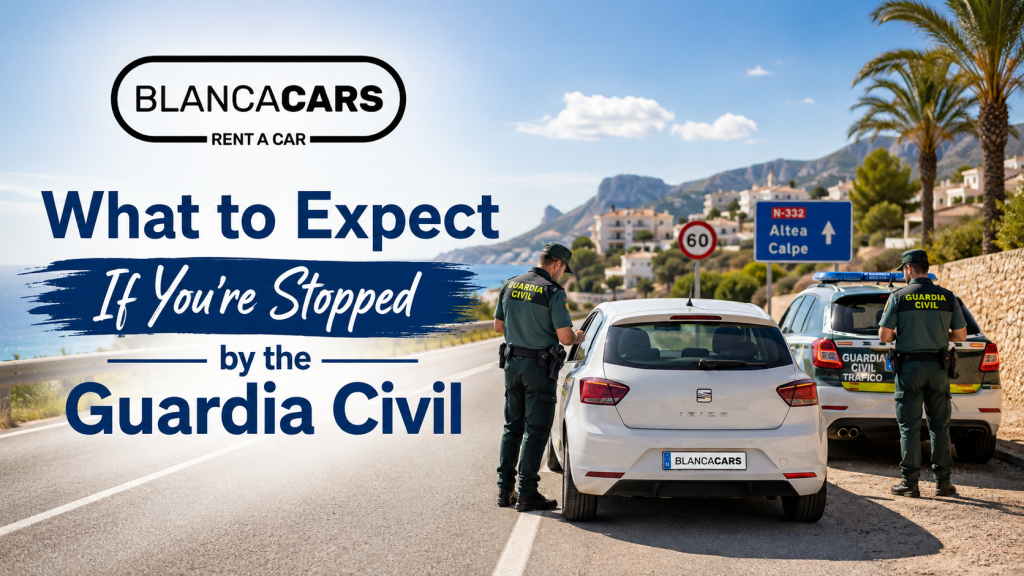
If you are driving a rental car in Spain and see a Guardia Civil vehicle behind you or officers directing vehicles into a roadside checkpoint, there is no reason to panic.
The Guardia Civil’s Agrupación de Tráfico is responsible for traffic monitoring and enforcement on most interurban roads in Spain. On the Costa Blanca, it is completely normal to see officers carrying out roadside checks on roads including the N-332, A-7, AP-7 and other routes.
You may be stopped because of a routine documentation check, an alcohol or drug-control campaign, a traffic offence, a vehicle issue or simply because officers are conducting preventive checks. Being stopped does not automatically mean you have done something wrong.
For Blanca Cars customers, the best approach is simple: stay calm, follow the officer’s instructions and have your driving documents ready.
How Will the Guardia Civil Tell You to Stop?
You may be directed into a checkpoint by an officer standing at the roadside.
Reduce your speed, follow the officer’s hand signals and stop exactly where you are instructed.
Spanish traffic law gives instructions from traffic officers priority over other road signs and signals, so their directions must be followed.
You may also be stopped by a Guardia Civil patrol car while you are driving.
If a police vehicle positions itself behind you and displays a flashing red light towards the front, Spanish traffic regulations require you to stop safely on the right-hand side, ahead of the police vehicle, somewhere that does not create additional danger or obstruct other road users. You should then remain inside the vehicle and follow any instructions given by the officer.
Do not suddenly brake or stop in a dangerous location.
Use your indicator, reduce your speed gradually and find the first safe place where you can stop as instructed.
Stay Inside the Car Until the Officer Approaches
Once you have stopped, remain calm.
Unless instructed otherwise, stay inside the vehicle and wait for the Guardia Civil officer to approach.
Switch off the engine if requested and lower your window so you can speak to the officer.
Do not start searching around the glove compartment or luggage area while the officer is approaching. Wait until you know which documents are required.
Keep your hands visible and simply follow the instructions you are given.
For most tourists, a Guardia Civil traffic stop is a straightforward and professional process that may only take a few minutes.
What Documents Can the Guardia Civil Ask For?
Spain’s DGT states that drivers must have the appropriate driving and vehicle documentation available. This applies to rental vehicles as well as privately owned cars.
You may be asked for:
- Your valid driving licence
- Passport or identification
- Vehicle registration document — Permiso de Circulación
- Vehicle technical inspection document — Tarjeta ITV / ficha técnica
- Your Blanca Cars rental agreement or booking information if requested
The required vehicle documents should be kept with the rental vehicle.
DGT specifically confirms that the vehicle registration and ITV documentation requirements also apply to rental cars.
It is therefore a good idea to know where the vehicle documents are located before beginning your journey.
What About a UK or Foreign Driving Licence?
For visitors travelling from another EU or European Economic Area country, a valid driving licence from that country is generally recognised in Spain.
DGT’s current guidance for foreign visitors states that drivers arriving from outside the EU/EEA should check whether they require an International Driving Permit, which should be carried together with the relevant passport or identity document.
If you are unsure whether your licence is valid for driving in Spain, check before travelling rather than waiting until you are stopped.
Blanca Cars customers should also make sure that every person driving the vehicle is authorised under the rental agreement.
Why Might the Guardia Civil Stop You?
There are many reasons why a vehicle might be stopped.
Sometimes officers are investigating a particular traffic offence such as speeding, using a mobile phone while driving or failing to wear a seatbelt.
At other times, the stop may have nothing to do with your individual driving.
The Guardia Civil regularly carries out preventive traffic-control operations.
Alcohol and drug checks are particularly common, and DGT data shows that the majority of positive alcohol and drug detections are found during preventive controls rather than after an accident.
These checkpoints can take place during the daytime or at night and on different types of roads.
They are especially visible during busy holiday periods, fiestas and major traffic operations.
What Happens During an Alcohol or Drug Check?
An officer may ask you to take a breathalyser test.
You could also be required to undergo a roadside drug test.
Drivers in Spain are required to cooperate with lawful alcohol and drug testing. Guardia Civil guidance states that drivers are obliged to submit to these tests when required.
If you are stopped for a routine alcohol test, simply follow the officer’s instructions.
The test is normally quick.
Do not assume you are being accused of drinking simply because you have been selected. Preventive roadside testing is a normal part of traffic enforcement in Spain.
For anyone driving a Blanca Cars vehicle, the safest policy is straightforward:
If you are driving, do not drink alcohol.
Will the Guardia Civil Check the Rental Car?
They may.
Officers can request the vehicle’s documentation and may notice obvious safety issues such as damaged tyres, defective lights or other problems.
This does not mean rental cars are specifically targeted.
Rental vehicles are subject to the same basic roadworthiness and documentation rules as other vehicles.
If an officer identifies a problem with a Blanca Cars vehicle that you were not previously aware of, contact Blanca Cars after the stop and explain exactly what the officer has told you.
Do not arrange independent mechanical repairs without speaking to us first.
What If You Don’t Speak Spanish?
Many Guardia Civil officers working in tourist areas deal regularly with international drivers, but you should not assume every officer will speak English.
Stay patient and polite.
A few useful phrases can help:
“No hablo mucho español.”
I don’t speak much Spanish.
“¿Habla inglés?”
Do you speak English?
“Es un coche de alquiler.”
It is a rental car.
“Tengo el contrato de alquiler.”
I have the rental agreement.
If communication is difficult, a translation application on your phone may help, provided the officer is happy for you to use it.
Do not become frustrated simply because communication takes a little longer.
What If You Receive a Traffic Fine?
If the officer believes a traffic offence has occurred, you may receive an official notice.
Read the paperwork carefully and make sure you understand which authority has issued the sanction.
For DGT traffic fines, the current procedure generally provides 20 calendar days in which to either pay the fine at the reduced rate or challenge it. In most applicable cases, payment during this voluntary period gives a 50% reduction, but accepting that reduction normally means giving up the right to appeal the fine.
Do not ignore a fine simply because you are driving a rental vehicle or because you will soon be leaving Spain.
Spanish traffic law allows authorities to require a rental company to identify the person who was driving the vehicle when an offence occurred.
If you receive paperwork and do not understand it, keep it and contact the relevant issuing authority for clarification.
What If You Are Stopped for Speeding?
If an officer tells you that you have exceeded the speed limit, remain polite even if you believe there has been a mistake.
Do not argue at the roadside.
Ask the officer to explain the offence and check the information provided on any official notice.
If you later believe the fine was issued incorrectly, Spain has formal procedures for making representations or appealing a DGT sanction.
The roadside is not the place to debate the case.
What If the Guardia Civil Asks You to Follow Them?
Occasionally an officer may instruct a driver to move the vehicle somewhere safer or follow the patrol vehicle.
Follow their directions.
The officer may simply want the vehicle moved away from traffic before completing the roadside check.
Do not drive away from a traffic stop until the officer clearly indicates that you are free to continue.
Are Guardia Civil Checks Different in Other Parts of Spain?
Yes.
The Guardia Civil’s Traffic Group manages road enforcement on most interurban roads, including those throughout the Costa Blanca.
However, some autonomous regions use their own traffic police.
DGT currently identifies the Mossos d’Esquadra in Catalonia, Policía Foral in Navarra and Ertzaintza in the Basque Country as authorities that perform equivalent traffic functions in their respective territories.
Local police generally handle traffic enforcement within towns and cities.
The basic principle is the same whichever authorised traffic police force stops you:
Follow the officer’s instructions and provide the requested documentation.
Before Driving Your Blanca Cars Rental Vehicle
There are a few simple things you can do to make any roadside check easier.
Know where your driving licence and passport are.
Know where the rental vehicle documentation is kept.
Keep your Blanca Cars rental agreement accessible.
Make sure everyone is wearing their seatbelt.
Do not use a handheld mobile phone while driving.
Follow Spanish speed limits and road signs.
Never drive after drinking alcohol or taking drugs.
And make sure only authorised drivers named under the rental arrangements drive the vehicle.
Frequently Asked Questions
Should I Be Worried If the Guardia Civil Stops Me?
No.
The Guardia Civil regularly carries out routine traffic and documentation checks. Being stopped does not necessarily mean you have committed an offence.
Should I Get Out of the Car?
If a police vehicle has stopped you from behind, Spanish traffic regulations say you should stop safely and remain in the vehicle, then follow the officer’s instructions.
Can the Guardia Civil Ask for My Driving Licence?
Yes.
Your driving licence is one of the main documents an officer can request during a roadside check.
Can They Ask for the Rental Car’s Documents?
Yes.
Rental cars are required to carry the appropriate vehicle registration and technical documentation.
Can I Be Breathalysed Even If I Haven’t Done Anything Wrong?
Yes.
Preventive alcohol and drug controls are routinely carried out on Spanish roads.
What Should I Do If I Receive a Fine?
Read the official notice carefully and identify the authority that issued it.
For most DGT fines eligible for the voluntary procedure, paying within 20 calendar days results in a 50% reduction but generally means giving up the right to appeal.
The Main Thing to Remember
If the Guardia Civil stops you while driving your Blanca Cars rental vehicle in Spain:
STAY CALM.
STOP SAFELY WHERE DIRECTED.
REMAIN IN THE VEHICLE UNTIL INSTRUCTED OTHERWISE.
BE POLITE AND COOPERATIVE.
PROVIDE YOUR DRIVING AND VEHICLE DOCUMENTS WHEN REQUESTED.
FOLLOW THE OFFICER’S INSTRUCTIONS.
For the vast majority of visitors, a roadside Guardia Civil check is simply a routine part of driving in Spain.
Having the correct documents, following Spanish traffic laws and understanding what to expect can make the whole experience quick and straightforward.
If the Guardia Civil identifies an issue relating specifically to your Blanca Cars rental vehicle or its documentation, contact Blanca Cars so we can help.
For official information aimed specifically at foreign drivers, Spain’s Dirección General de Tráfico (DGT) provides up-to-date guidance covering documents, traffic rules and the authorities responsible for road enforcement.